Sourcing and supply development services with assured quality control measures and inspection reports at every stage of the process.
The process of quality control and inspection is a core component of success in the manufacturing and export business. Quality control involves inspection of raw materials, parts that are fabricated or machined, sub-assemblies, and finished products. It starts from when the materials and parts are purchased during the process, until the finished product is ready for delivery.
The ESSNPS team has the right engineering skills to conduct quality control & inspection in manufacturing without disrupting the production, thereby avoiding delays.
Our engineers are qualified and certified by ASNT Level II, which was developed by the American Society for non-destructive testing for certification of welding inspectors. Additionally, all our inspectors go through significant amount of internal training and constant testing. Our engineers are trained to carry out destructive and non-destructive tests, used to examine and qualify finished welds i.e. visual, liquid penetrant, magnetic particle, ultra-sonic and radiographic as required.
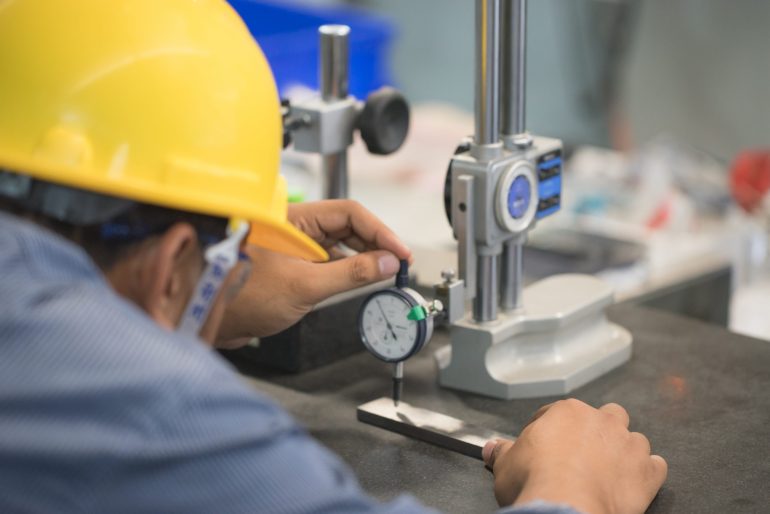
Bought out items are checked and verified to ensure that they conform to the specifications agreed upon, and there is no sign of any visible damage, etc. The mating parts are checked for fitment after receipt of such items. We also ensure that the supplier continues to be available for replacing any parts, in case any warranty or guarantee issues arise.
Fabricated equipment, parts & structures are a major part of any plant in the industry. There are simple and complex parts, with intricate shapes with special requirements and different metals being welded. Many characteristics of a weld are evaluated during welding inspection, some related to the weld size, and others relating to the presence of welding defects.
The inspection team at ESSNPS is proficient at measurement and verification of dimensions using a coordinate measurement machine (CMM), calipers, micrometers, surface plates, angle plates, height gages, dial indicators, gage blocks, gage pins, Ra testers, etc. All the parts are monitored at various stages and in the final inspection for dimensions, tolerances, clearances, overall finish, etc.
The most important aspect in quality control & inspection is reporting and documentation. Inspection reporting is done through a well-established and stage-wise verification and transparent reporting processes using a knowledge-based software that was developed in-house. The buyer may also specify the format to be used for the items. ESSNPS follows the procedure agreed upon and maintains proper documentation and relevant records.
FAT is the final check carried out before the items are dispatched. It helps to gain proof of functionality, quality, and integrity with our comprehensive checking process. These are conducted as per the terms agreed upon, and may include visual checks, overall dimensions related to assembly, random sampling, etc. Approval is sought on the FAT conducted before packaging and shipment.
Use of the correct methods and processes at each stage, ensures integrity and good manufacturing practices, with zero defects. Procedures are defined to ensure the highest quality of products and components that are inspected.
Once the order is placed, the team works meticulously with a detailed plan to document every detail of raw materials and consumables, fittings, and all the manufacturing processes to ensure complete traceability of the sourced products.
ESSNPS has a dedicated team of experts in varied disciplines and qualified from international certification agencies to ensure quality control & inspection to meet the expectations of the customer. They also have experience in manufacturing engineering and ensure that best practices are followed at every stage to achieve the desired quality of the product.
Over the last decades, ESSNPS has acquired valuable insights into sourcing & procurement services, and in the process, built strong capabilities in this area.





There is no compromise on quality, hence the need for constant vigilance. It is one thing to set the parameters at the outset spelling out the requirements. But what is important is to follow the details in practice with continuous monitoring of all the products for quality with routine as well as random checks, keeping records of the deviations, and timely intervention to get the anomalies corrected. All these are critical issues that the ESSNPS team is extremely proficient with.
Usually buyers suffer when they deal with suppliers without understanding their capabilities, which leads to problems. Often, suppliers accept the order and fail to deliver, which can cause serious bottlenecks in production. In fact, this is the biggest problem a company can face, because there was no proper due diligence carried out in the preliminary stage. This is where professionals can help with their experience and familiarity with the complexities that the process entails. These sourcing & procurement companies not only find the right supplier, but also continue to monitor the services to ensure all the delivery demands and standards are met. For the buyer, it is then only a matter of conducting regular reviews and insisting on remedial actions in case of any abnormality.
This is a valid concern but misplaced because quality can be compromised even if a company does this activity in-house, if there are no inspections or quality control audit checks and balances. Professional sourcing & procurement companies are not only familiar with the products and components, but also the quality control aspect and the various inspection requirements. These constitute a part of the terms and conditions and there are checklists to follow with active participation from the client in verifying all the quality parameters at each stage.
Often companies take the easy way out and finalize on a deal with a supplier without entering a formal contract. Professional sourcing & procurement service providers are trained to look out for these issues and help to create binding legal contracts and the necessary paperwork, which can be a difficult task for a company, given its priorities. The solution is to rely on professionals to help in these matters as they are not only familiar with the process but also have ready templates for entering into such contracts that are binding, thereby assuring a healthy supply chain.